

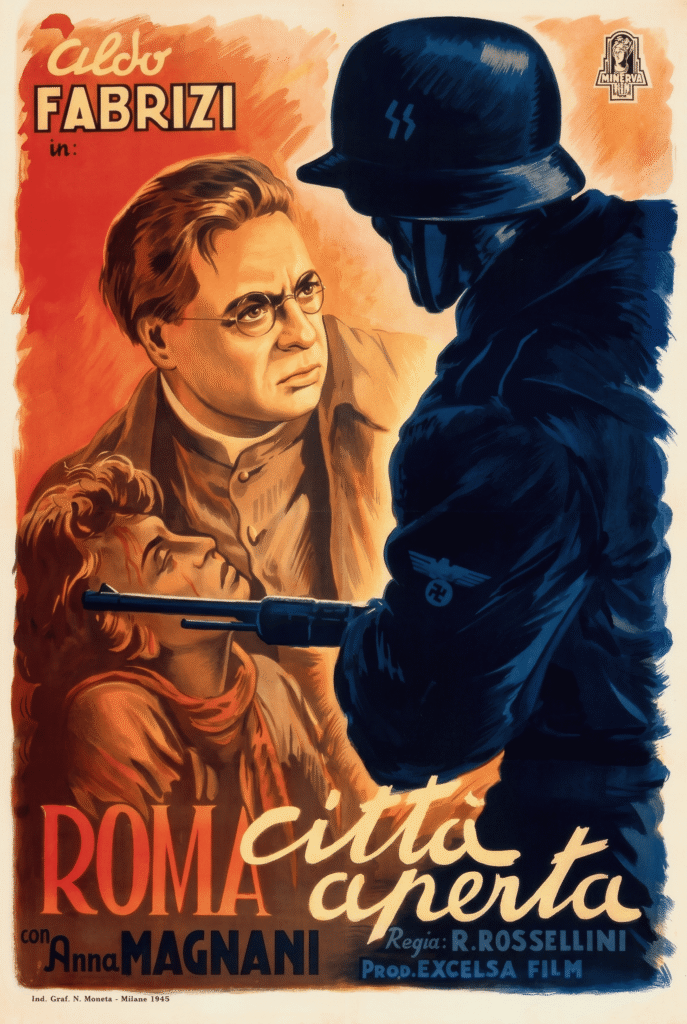
Original title: Roma città aperta
Based on: Original screenplay by Sergio Amidei and Federico Fellini
Director: Roberto Rossellini
Screenplay: Sergio Amidei, Federico Fellini, Roberto Rossellini
Cinematography: Ubaldo Arata
Music: Renzo Rossellini
Cast: Anna Magnani, Aldo Fabrizi, Marcello Pagliero, Vito Annichiarico, Nando Bruno, Harry Feist, Maria Michi, Francesco Grandjacquet, Giovanna Galletti, Carla Rovere
Filming locations: Parrocchia di Sant’Elena, Via Casilina 205, Rome, Lazio, Italy; Rome, Italy (on location)
Subtitles: English (EN), Romanian (RO)
Synopsis and Main Themes: In German-occupied Rome in 1944, a communist Resistance leader named Manfredi is hunted by the Gestapo. He finds refuge with Francesco, a working-class printer engaged to Pina, and turns to Don Pietro, a parish priest, to carry money and messages to the underground. The film follows these characters — a communist, a Catholic priest, a working-class woman, a child — as their fates converge under occupation. At its center is a question about what holds a community together when the state has become the enemy: not ideology, but solidarity, love, and the willingness to die for someone else’s cause.
About the Director and Cinematic Style: Roberto Rossellini was born in Rome in 1906 and had made several films under the Fascist regime before the Liberation. Rome, Open City was his first postwar film and the work that transformed both his career and the course of world cinema. Shot in January–June 1945 on scraps of mismatched film stock — some German, some Italian — with mostly non-professional actors, in actual Roman streets still bearing the damage of occupation, the film developed its visual language from necessity rather than choice. The result was a roughness and immediacy that no studio production could have manufactured: a texture critics immediately recognized as something genuinely new and named Italian neorealism.
Critical Reception and Impact: Rome, Open City shared the Grand Prix du Festival at Cannes in 1946 and received an Academy Award nomination for Best Screenplay at the 19th ceremony — the first Italian film to receive an Oscar nomination in the postwar period. Anna Magnani won the National Board of Review’s Best Actress prize, and the film won the New York Film Critics Circle Award for Best Foreign Language Film. It ran for two consecutive years in New York and grossed three million dollars at the American box office — an extraordinary figure for a foreign-language film playing mainly in independent theaters. The Italian Nastro d’Argento awarded it Best Film and Best Supporting Actress for Magnani.
Historical Context and Cinematic Legacy: Rome, Open City was the first in Rossellini’s neorealist trilogy, followed by Paisan (1946) and Germany, Year Zero (1948). It was recognized immediately — by André Bazin, by the critics of Cahiers du cinéma, by filmmakers across Europe and beyond — as a rupture with the existing language of cinema: a film that placed the camera in the world rather than constructing the world around the camera. Its influence on subsequent filmmaking is virtually incalculable. The French New Wave, the Brazilian Cinema Novo, Iranian cinema, and the American independent movements of the 1960s and 1970s all drew from the aesthetic license Rome, Open City demonstrated was possible. It is one of the small number of films that genuinely changed what cinema thought it could do — and did so by having no choice but to be honest.
You cannot copy content of this page

It's free. No subscription required
Comentarii (0)
Please login to comment.
Please login to review.