ENGLISH:
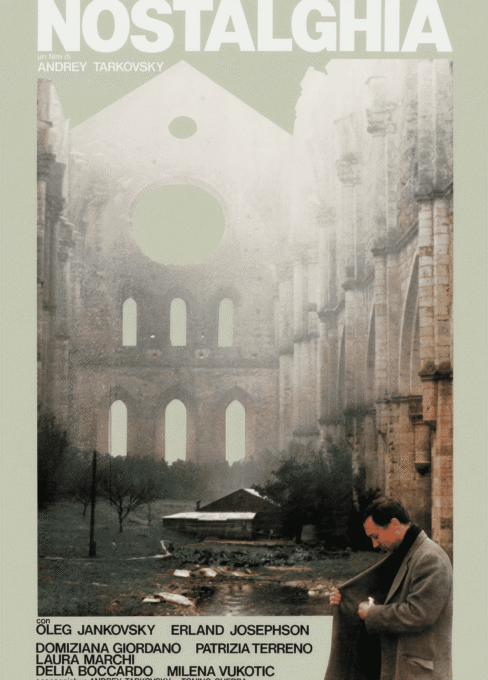
Original title: Nostalghia
Based on: Original screenplay by Andrei Tarkovsky and Tonino Guerra
Director: Andrei Tarkovsky
Screenplay: Andrei Tarkovsky, Tonino Guerra
Cinematography: Giuseppe Lanci
Music: Ludwig van Beethoven; Giuseppe Verdi; Johann Sebastian Bach
Cast: Oleg Yankovskiy, Erland Josephson, Domiziana Giordano, Patrizia Terreno, Laura De Marchi, Delia Boccardo, Milena Vukotic
Filming locations: Tuscany, Italy — Bagno Vignoni, San Galgano Abbey, Terme di Saturnia
Subtitles: English (EN), Romanian (RO)
Synopsis and Main Themes: Andrei Gorchakov, a Russian poet researching an 18th-century composer in Italy, finds himself paralyzed by homesickness in the Tuscan countryside. He cannot work, cannot love, cannot bridge the distance between himself and the world around him. His only meaningful encounter is with Domenico, a man considered mad by the community — between them, a strange kinship forms, the kinship of those who cannot compromise with the present. The film explores the pain of exile, the impossibility of belonging to two places at once, and the weight of a homeland one can no longer return to.
About the Director and Cinematic Style: Nostalghia was Tarkovsky's first film made entirely outside the Soviet Union, shot in Italy as a co-production between RAI and Sovinfilm. Giuseppe Lanci's deliberately desaturated cinematography creates an atmosphere of suspension and loss. Tarkovsky moves through the Tuscan landscape as through a dream: ancient thermal pools, ruined abbeys, rain-soaked interiors become extensions of Gorchakov's inner state. The film's central sequence — carrying a lit candle across a drained pool without the flame going out — is one of the most celebrated in all of cinema: a ritual of pure, irrational faith.
Critical Reception and Impact: Nostalghia won the FIPRESCI Prize and the Prize of the Ecumenical Jury at the 1983 Cannes Film Festival, where it also competed for the Palme d'Or. Critics recognized in it the full maturity of Tarkovsky's late style. Soviet authorities refused to allow it to represent the USSR at the Academy Awards — a decision that confirmed the irrevocable break between Tarkovsky and his homeland.
Historical Context and Cinematic Legacy: Made in the final years of the Cold War, Nostalghia is a film haunted by the impossibility of return — both personal and political. Tarkovsky would never go back to Russia. Shortly after completing the film, he held a press conference in Milan announcing his decision to remain in the West, a moment of immense personal anguish that cast a retrospective shadow over every frame. The film's meditation on displacement, cultural untranslatability, and the specific pain of longing for a place that is no longer accessible has resonated deeply with artists and audiences across decades. Alongside the work of Chantal Akerman and Abbas Kiarostami, it remains one of the most profound cinematic treatments of exile — a condition Tarkovsky did not merely depict but lived, and from which he would never recover.
You cannot copy content of this page

It's free. No subscription required