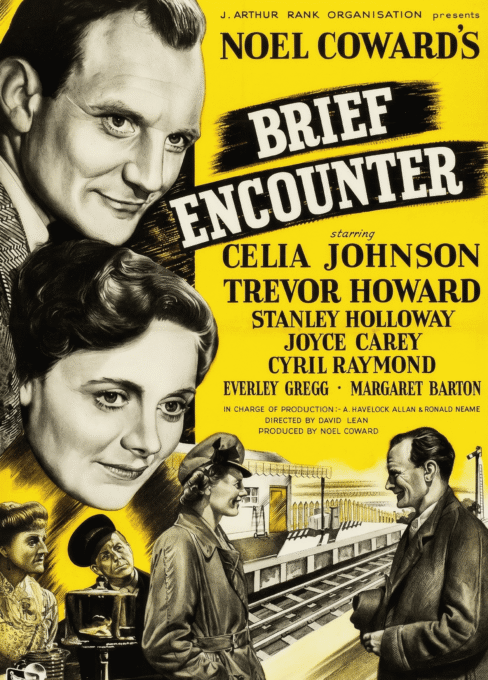
Synopsis and Main Themes: Laura Jesson, a married suburban housewife, meets Dr. Alec Harvey by chance at a railway station when he removes a piece of grit from her eye. Over several Thursday afternoons, they meet again — for lunch, a film, a walk — and fall into a love neither of them names or acts upon. The film is narrated by Laura in a sustained interior monologue, addressed to her oblivious husband as he sits across from her doing a crossword. It is a study in restraint as tragedy: not what these two people do, but everything they do not do, and what that costs them.
About the Director and Cinematic Style: David Lean was born in Croydon in 1908 and came to cinema as an editor, cutting some of the most important British films of the 1930s before turning to direction in 1942. Brief Encounter was his fourth collaboration with Noël Coward — the fourth and final — and the film in which his mature visual sensibility first fully declares itself. Robert Krasker's photography wraps the station, the streets, and the borrowed rooms in fog, steam, and shadow, giving the English suburbs the texture of a suppressed dream. Lean's editing — trained to a fine precision over years at the cutting table — controls the rhythm of the film with the same discipline that controls his characters: nothing released that should be held back.
Critical Reception and Impact: Brief Encounter shared the Grand Prix du Festival at Cannes in 1946 — the recognition that persuaded the major French distributor Gaumont to take the film after initially declining it. At the 19th Academy Awards, it received three nominations: Best Director, Best Actress for Celia Johnson, and Best Screenplay — without winning. Celia Johnson won the New York Film Critics Circle Award for Best Actress. The film's first preview, before a working-class audience in Rochester, was a disaster — the audience laughed through the most romantic scenes. Its subsequent critical reputation proved to be precisely the inverse: the BFI placed it twelfth on its list of the greatest British films ever made.
Historical Context and Cinematic Legacy: Brief Encounter was shot in early 1945 at Carnforth Station in Lancashire — chosen because it was far enough from major cities to avoid wartime blackouts during filming — as the war was still under way and British society was still organized around duty, sacrifice, and the suppression of private need. The film's central refusal — the love affair that does not happen — reads differently depending on whether one sees it as an endorsement of social constraint or as its most devastating critique: Lean and Coward give us a woman who obeys every rule and pays for it with everything that might have made her alive. The film's influence on subsequent cinema about repressed or forbidden love is pervasive, from the French New Wave to Wong Kar-wai's In the Mood for Love (2000), whose debt to Brief Encounter has been widely acknowledged. Rachmaninoff's Second Piano Concerto, heard throughout the film, has been inseparable from the image of suppressed longing ever since.
You cannot copy content of this page

It's free. No subscription required