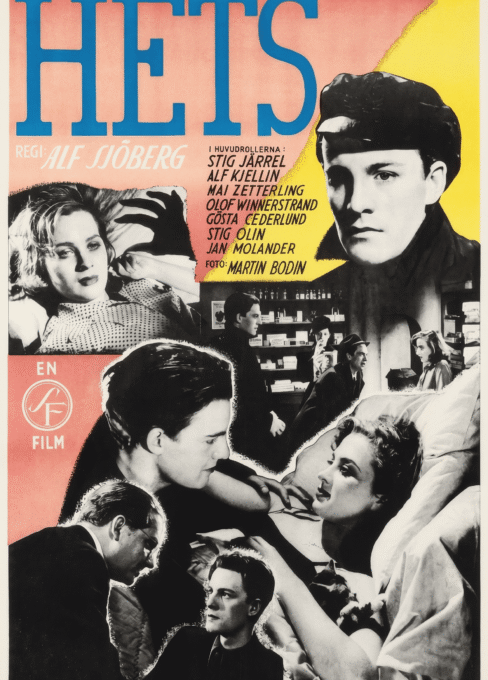
Synopsis and Main Themes: At a Stockholm secondary school, a sadistic Latin teacher known to his students as "Caligula" rules his classroom through fear and humiliation. His most diligent student, Jan-Erik, falls in love with Bertha, a young woman who works in a cigarette shop — and discovers that the same man who terrorizes him at school is also tormenting her in private. The film moves from institutional satire to thriller to tragedy, driven by the question of how much cruelty an institution can absorb before those inside it break. The teacher's makeup was deliberately designed to evoke Himmler, and the film was widely read as an allegory of fascism operating within the structures of everyday life.
About the Director and Cinematic Style: Alf Sjöberg was born in Stockholm in 1903 and built his reputation primarily as a stage director at the Royal Dramatic Theatre, where he would remain a dominant figure for half a century. Torment was his most internationally significant film and the work that brought Swedish cinema to Cannes for the first time. The screenplay was written by the then twenty-four-year-old Ingmar Bergman — his first filmed scenario — who also served as assistant director on the production. Bergman later recalled filming some of the final exterior sequences himself while Sjöberg was otherwise occupied: those images, he wrote, were his first professionally filmed frames, and he considered them his true directorial debut. Martin Bodin's expressionist photography — heavy shadows, disorienting angles — gives the film a visual intensity that prefigures Bergman's own later work.
Critical Reception and Impact: Torment shared the Grand Prix du Festival at the inaugural Cannes Film Festival in 1946, bringing Swedish cinema its first major international recognition. In Sweden, the film provoked fierce public debate about conditions in secondary schools — the principal of Bergman's own former school published a letter in the press disputing his account of student life. Critics praised the ferocity of Stig Järrel's performance as Caligula — widely described as one of the most terrifying characterizations in Swedish film history — alongside Mai Zetterling's delicate, damaged Bertha and Martin Bodin's expressionist cinematography.
Historical Context and Cinematic Legacy: Torment was made in 1944, as Sweden maintained its precarious wartime neutrality surrounded by German-occupied territory, and its portrait of a sadistic authority figure modeled visually on Himmler carried a political charge that contemporary Swedish audiences could not have missed. The film belongs to a tradition of institutional critique that runs through European cinema from Lang to Vigo, and its specific treatment of adolescent powerlessness anticipates the school films of the French New Wave. Its legacy is inseparable from Bergman's: Torment launched his career as a screenwriter, gave him his first experience behind the camera, and established the themes — guilt, cruelty, the abuse of authority, the destruction of the innocent — that would define his own directorial work from Crisis (1946) onward. Alf Sjöberg went on to win a second Grand Prix at Cannes in 1951 for Miss Julie, cementing his standing as a major figure of European cinema despite remaining far less known internationally than his protégé.
You cannot copy content of this page

It's free. No subscription required