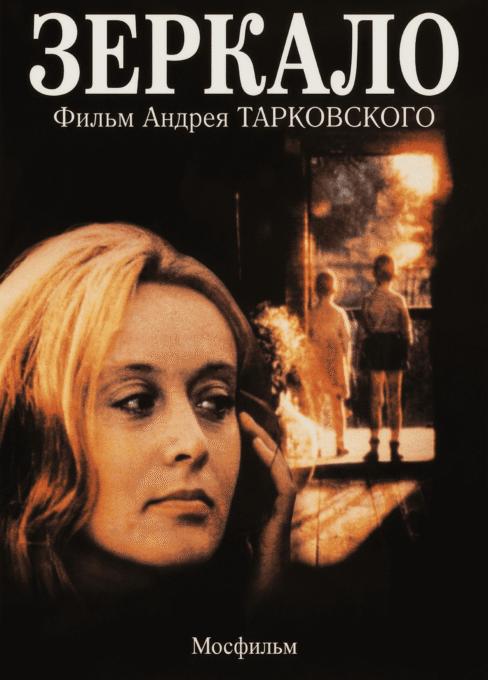
Original title: Zerkalo
Based on: Original screenplay by Aleksandr Misharin and Andrei Tarkovsky
Director: Andrei Tarkovsky
Screenplay: Aleksandr Misharin, Andrei Tarkovsky
Cinematography: Georgy Rerberg
Music: Eduard Artemyev; J.S. Bach; Henry Purcell; Giovanni Pergolesi
Cast: Margarita Terekhova, Filipp Yankovskiy, Ignat Daniltsev, Oleg Yankovskiy, Nikolay Grinko, Alla Demidova, Yuriy Nazarov, Anatoliy Solonitsyn, Larisa Tarkovskaya, Innokentiy Smoktunovskiy (voice), Arseniy Tarkovskiy (voice)
Filming locations: Tuchkovo, Moscow Oblast, Soviet Union
Subtitles: English (EN), Romanian (RO)
Synopsis and Main Themes: A middle-aged man lies dying, and through a stream of memories, dreams, and newsreel footage, the film reconstructs the fragmented landscape of his inner life. Past and present dissolve into one another: a wartime childhood, a strained marriage, a mother who endured the hardships of the Stalin era, and the haunting persistence of guilt and longing. Tarkovsky interweaves personal autobiography — his own family history, his mother, his father's poetry — with the broader history of Russia. The film explores time, identity, memory, and the impossible distance between who we were and who we became.
About the Director and Cinematic Style: The Mirror is perhaps the most personal film Tarkovsky ever made. Drawing on his own childhood and the life of his mother, he abandons conventional narrative entirely in favour of a lyrical, associative structure, moving freely between colour and black-and-white, between present and past, between documentary and dream. Georgy Rerberg's cinematography achieves a rare quality of luminous fragility — every image seems held in suspension, on the verge of dissolving. The verses of Arseniy Tarkovsky, the director's father, bind the film's emotional layers together.
Critical Reception and Impact: Upon its release in the Soviet Union in 1975, The Mirror was met with official indifference and hostility — given limited distribution and screened primarily in small venues. Yet audiences who saw it responded with extraordinary intensity, many writing to Tarkovsky that the film had captured experiences from their own lives. Internationally, it has come to be regarded as one of the supreme masterworks of world cinema — a film that seems to speak directly to the innermost recesses of personal experience.
Historical Context and Cinematic Legacy: Made in the mid-1970s, The Mirror was born from a Soviet cultural climate increasingly hostile to introspective, non-ideological art. That Tarkovsky was able to complete such a radically personal work at all is remarkable — Soviet authorities would further restrict his creative freedom after this film, accelerating the path toward his eventual exile. The film's influence has been vast and enduring: its fragmented, memory-driven structure has shaped filmmakers from Terrence Malick to Aleksandr Sokurov to Carlos Reygadas. More than any other single work, The Mirror expanded the possibilities of what cinema could express about the inner life — proving that a film could function not as narrative but as pure remembrance. It remains one of the most searching explorations of memory and time ever committed to film.
You cannot copy content of this page

It's free. No subscription required