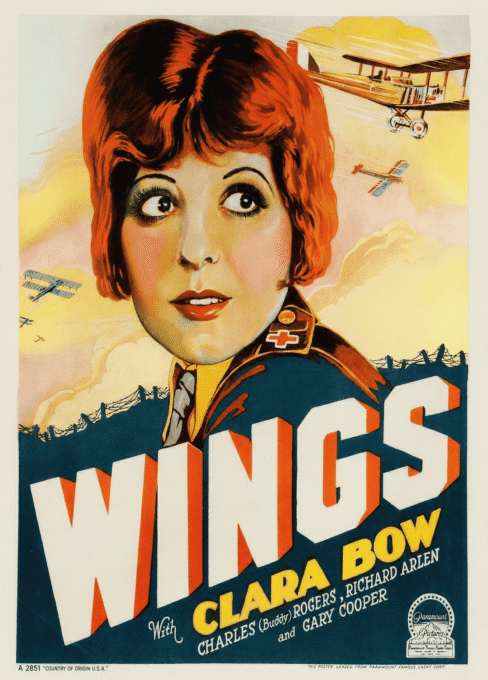
Original title: Wings
Based on: Original story by John Monk Saunders
Director: William A. Wellman
Screenplay: Hope Loring, Louis D. Lighton
Cinematography: Harry Perry
Music: J.S. Zamecnik
Cast: Clara Bow, Charles "Buddy" Rogers, Richard Arlen, Jobyna Ralston, Gary Cooper, El Brendel, Henry B. Walthall, Roscoe Karns, Gunboat Smith, Richard Tucker
Filming locations: Kelly Field, Brooks Field, and Camp Stanley, San Antonio, Texas
Subtitles: English (EN), Romanian (RO)
Synopsis and Main Themes: Jack and David, two young Americans from the same small town — one middle class, the other wealthy — are both in love with the same woman. When America enters the First World War, both enlist as fighter pilots. Their romantic rivalry transforms into friendship on the French front, where they become flying aces. Meanwhile, Mary, the neighbor who secretly loves Jack, follows him to the front as an ambulance driver. The tragedy of war turns adventure into loss, and the cost of glory proves devastating. The film explores male camaraderie, sacrifice, lost innocence, and the absurdity of a war that destroys the very things it claims to defend.
About the Director and Cinematic Style: William A. Wellman, a World War I veteran who had flown as a combat pilot in the Lafayette Flying Corps, brings to the film a visceral authenticity that no other Hollywood director could offer. The aerial sequences — filmed with cameras mounted directly inside biplane cockpits — were revolutionary, giving audiences the sensation of flight for the first time in cinema history. Wellman coordinated hundreds of extras, 300 real pilots, and United States Army aircraft with orchestral precision, recreating the Battle of Saint-Mihiel on a scale that anticipated modern war blockbusters by decades.
Critical Reception and Impact: Wings won the first Best Picture Oscar (Outstanding Picture) at the 1929 ceremony, remaining the only fully silent film ever to receive this award. It also won the Oscar for Best Engineering Effects. The production, with a budget of $2 million — colossal for the era — was a commercial triumph that confirmed Paramount's status as a top studio. Gary Cooper's brief appearance in a supporting role was instrumental in launching his Hollywood career.
Historical Context and Cinematic Legacy: Produced between September 1926 and April 1927, and dedicated to the fallen pilots of World War I, Wings appeared at a time when America was still processing the traumas of the Great War, and public fascination with aviation — amplified by Charles Lindbergh's transatlantic flight in May 1927 — was at its peak. The film set the standard for all aviation films to follow, from Hell's Angels (1930) to Top Gun (1986), through the realism of its aerial combat scenes, filmed without special effects, with real pilots in real aircraft. Selected in 1997 for the National Film Registry of the Library of Congress, Wings remains a monument to cinematic ambition and proof that grand spectacle and authentic emotion are not mutually exclusive.
You cannot copy content of this page

It's free. No subscription required